The plan – and why it sounded sensible
A meal was coming up that evening, and I knew it carried carbohydrates: beef strips with sweet potato, a tomato tortilla and a protein yoghurt. My established way of handling that is movement. So at about 19:57 I got on the bike for 30 minutes of low impact riding plus a five-minute cool-down.
I knew the pattern from earlier the same day. I had already ridden at midday, and it had worked – at least in the sense in which I understood „worked“ back then.
The morning as a contrast
At about 11:57 a 30-minute ride began. My value was around 143 mg/dl at the time, having climbed slowly through the morning. After the training, at 12:32, it stood at 87 mg/dl – with a falling arrow. A drop of roughly 56 points.
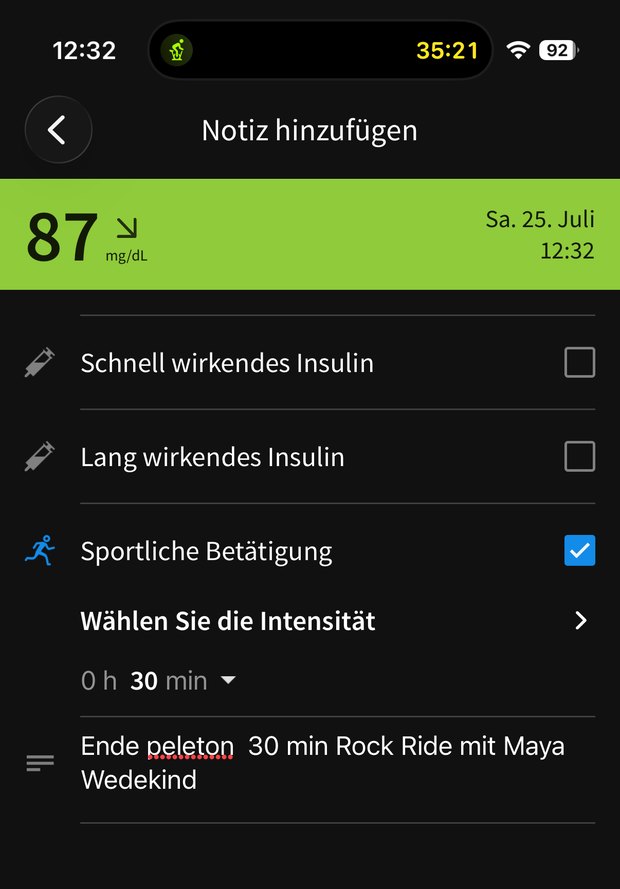
At the time I thought: that went well. By 13:21 I was back at 118, and the afternoon passed quietly between 105 and 125. In hindsight that was already the first hint I read past – training that pushes the value down by more than 50 points is not working against a meal. It is working against my reserves.
The evening: 69 mg/dl
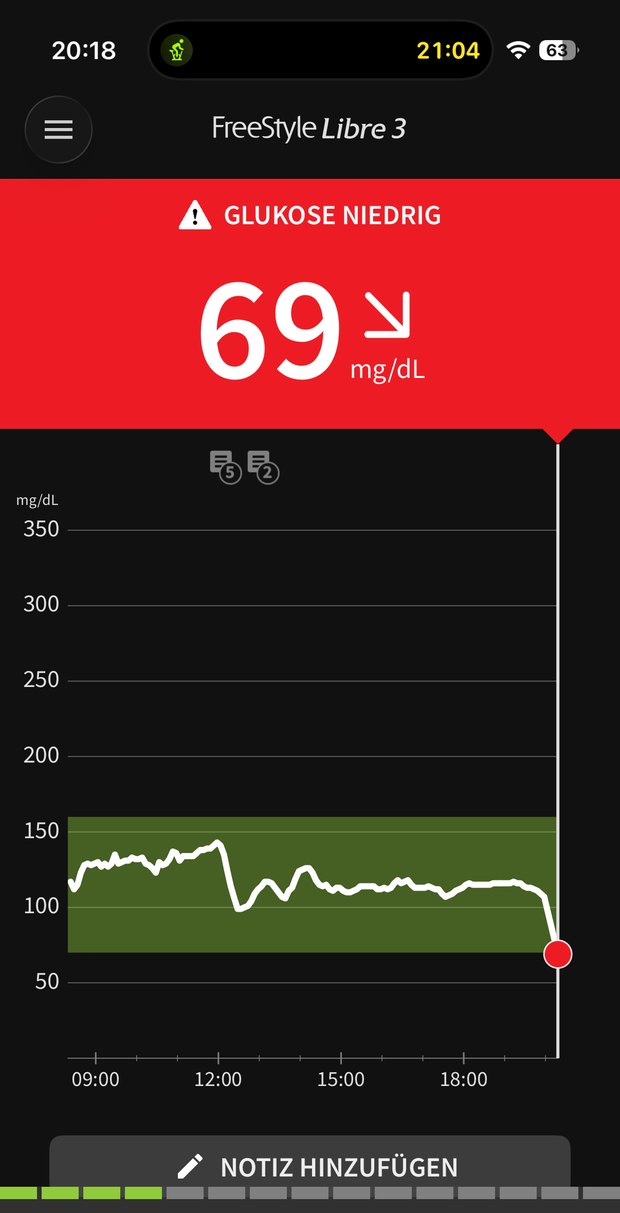
At 20:18, a good 20 minutes into the second session, the app reported low glucose. 69 mg/dl, arrow still pointing down. I had trained before there was anything to metabolise – and the muscle took what it needed from the blood.
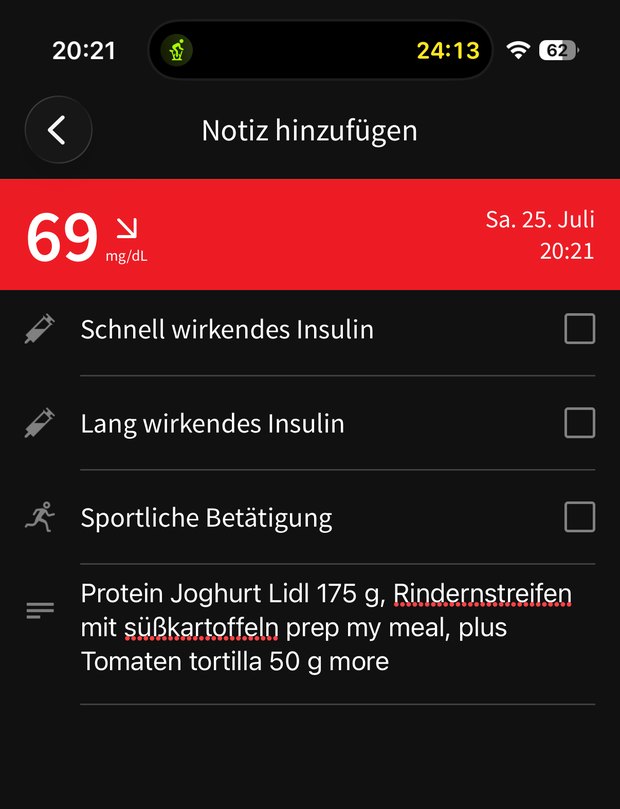
Three minutes later I ate and logged it in the app. Not as a countermeasure against the low value, but because the meal was due anyway. That very simultaneity became the problem.
And then: 183
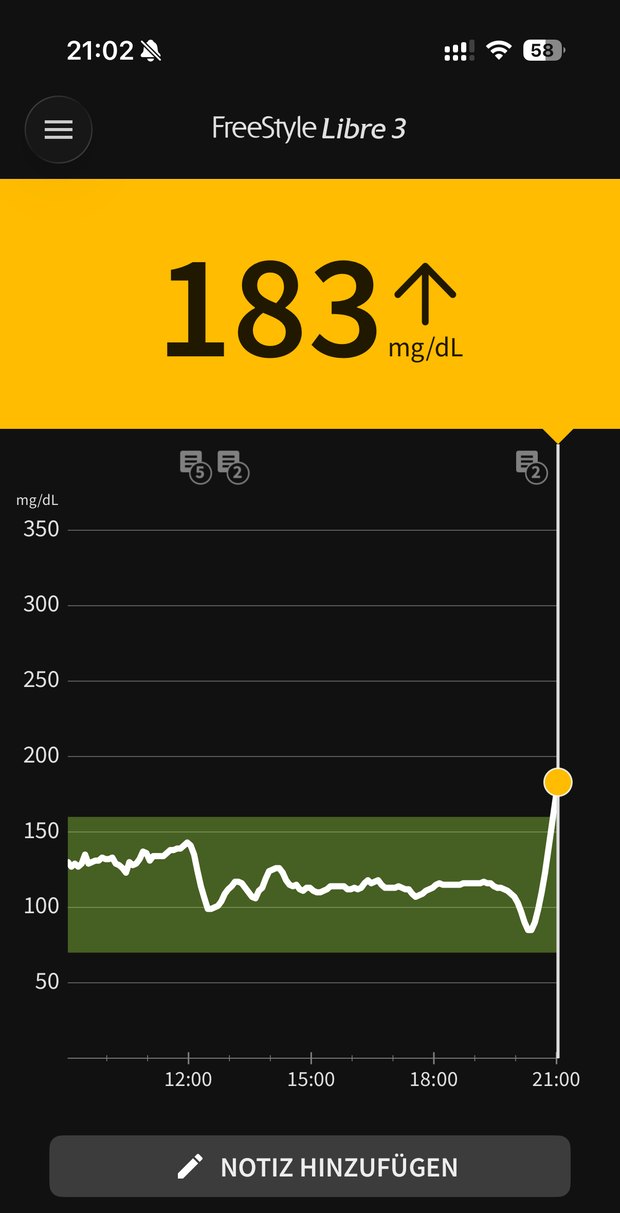
At 21:02 the display read 183 mg/dl, arrow climbing steeply. In a good 40 minutes my value had risen by 114 points. That is more than the meal alone explains – sweet potato and a 50-gram tortilla are hardly a sugar bomb.
What actually happened
Two sources of glucose arrived at the same time. One came from outside, the other from within me.
The liver steps in. When blood sugar falls towards 70, that is a signal for the body. Glucagon rises and the liver releases stored glucose. This is not a defect but a protective mechanism – it stops the value dropping further.1 It simply keeps running when supplies from outside are already on their way.
Fat delays the meal. Beef strips and tortilla bring fat with them, and fat slows gastric emptying. The carbohydrates from the sweet potato therefore did not arrive at once but with a lag.2 Precisely at the moment when the liver was already delivering.
Movement lowers blood sugar reliably – but only while it lasts, and only while there is something to burn.3 My ride was over at 20:32. The rise began after that. I had placed the movement where there was nothing yet, and it was missing where the peak arrived.
The walk afterwards
At 21:04 I set off. Nine minutes, 799 metres, average heart rate 121 – no athletic feat, more a stroll around the block in Bad Neuenahr-Ahrweiler.
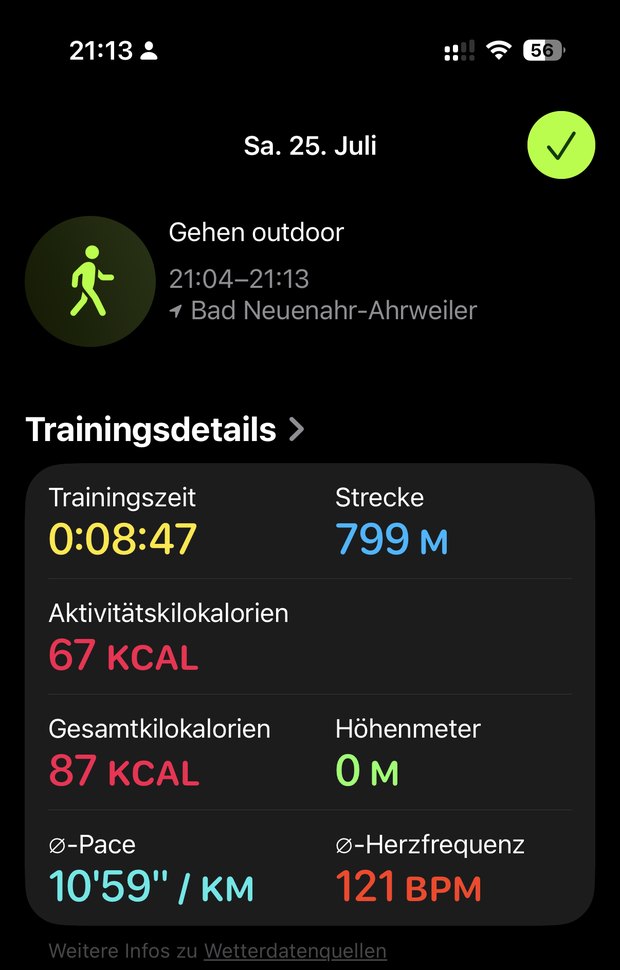
My impression that evening was that this short walk did more than the half hour on the bike before it. That sounds contradictory, but it is plausible: the walk sat inside the rise, the ride sat before it. In matters of timing, placement beats intensity.
How it ended
The peak did not last. By 21:30 I was at around 128, by 21:45 at about 108 – back in the target range, a good 45 minutes after the high point. The night then stayed calm: a flat wave between 110 and 126, with no second swing. At 00:29 the display read 104 mg/dl with a level arrow.
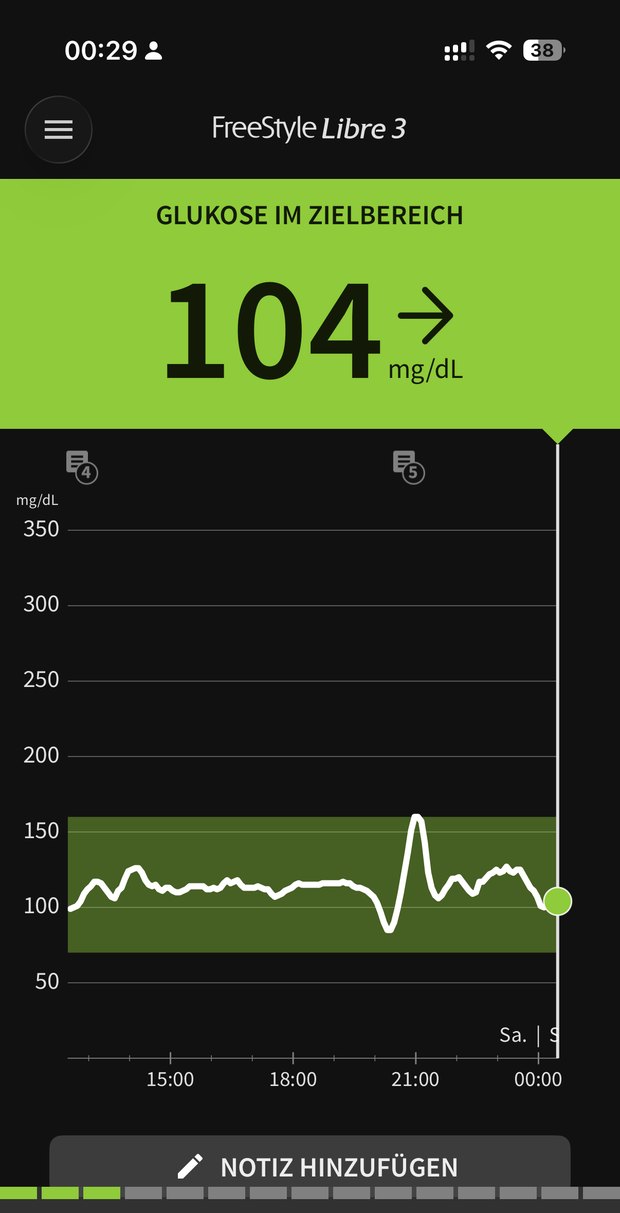
That answers the earlier question, at least for this one evening: the swing stayed an episode. No after-burn, no second rise around midnight, no rebound low. Whether the walk caused that, or whether the curve would have turned anyway, cannot be separated from a single case – that would need the same evening without the walk. What is certain: the fall began immediately afterwards.
In the 12-hour window the curve shows a high of about 160 mg/dl and a low of around 86 – yet what I measured was 183 and 69. The wider the time window, the more the display smooths the peaks away. Anyone looking only at the daily curve underestimates both extremes. The spot readings are the more reliable basis.
What I take from it
The mistake was not the movement. It was assuming that movement before a meal does the same job as movement during the rise. With a fatty meal the peak shifts backwards – and my buffer was long behind me by the time it was needed.
There is a second point I had never seen this clearly before: a low value is not merely a low value. It provokes a counter-movement that helps drive the later rise. Anyone who works their way below 70 is then fighting on two fronts.
I take no glucose-lowering drugs – for me 69 mg/dl was unpleasant but manageable. On insulin or sulfonylureas the same number looks different: there, training on empty stores can lead to a genuine hypo. Anyone taking such medication should settle training times and meal intervals with their doctor rather than choosing them from a blog article.
How I will try it next time
Not riding before the meal but after it – and later than feels right. With a fatty meal, rather 45 to 60 minutes of distance than straight afterwards. Shorter and easier instead of 30 minutes in one block.
The evening ended on a conciliatory note, and that is exactly what makes it instructive: a value of 183 is no disaster if it stays an episode. More interesting than the peak is how quickly it resolves. What is still missing is the counter-test – the same meal, the same timing, but without the walk around the block. Only that would show how much of it really was the movement.
Key takeaways
- Two rides on the same day: 143 to 87 mg/dl at midday, down to 69 mg/dl in the evening.
- At 20:18 a low glucose alarm – the training came before the meal, not after it.
- After eating at 20:21 the value climbed to 183 mg/dl by 21:02: +114 in a good 40 minutes.
- Two sources coincided: liver glucose from counter-regulation, and the delayed carbohydrates of a fatty meal.
- The training ended at 20:32 – that is, before the rise had even begun.
- A nine-minute walk at 21:04, by contrast, sat right inside the rise.
- By 21:45 the value was back in range and the night stayed calm – 104 mg/dl at 00:29.
- The 12-hour view smooths the peaks: it shows 160 and 86, whereas the measurements were 183 and 69.
Sources
Sources as of: 25 Jul 2026.
- Counter-regulation as blood sugar falls: glucagon and adrenaline trigger glucose release from the liver; the mechanism starts within the lower normal range. Review. ncbi.nlm.nih.gov/PMC5375488 (öffnet in neuem Fenster)
- Fat slows gastric emptying and shifts the glucose peak later; mixed meals therefore act later and flatter, but for longer. Diabetes Care. care.diabetesjournals.org (öffnet in neuem Fenster)
- Physical activity, GLUT-4 and insulin sensitivity: insulin-independent glucose uptake in muscle; acute during and shortly after a session. PMC (2020). pmc.ncbi.nlm.nih.gov/PMC7235686 (öffnet in neuem Fenster)